

Masala chai is a spiced milk tea made by simmering black tea with a blend of aromatic spices, water, milk, and a sweetener — all in one pot, all at once, until the flavors meld into something genuinely warming. The flavor is layered: floral from cardamom, fiery from ginger, with a milky, slightly sweet finish that lingers. For a quick taste, you only need three things to start: a teaspoon of black tea, a few crushed cardamom pods, and a splash of whole milk simmered together for five minutes. That’s the soul of it, right there.
Table of Contents
- What goes into masala chai?
- How to make traditional masala chai on the stovetop
- Faster methods and popular variations
- What does each spice actually do?
- Where masala chai came from
- How does masala chai compare to karak chai and chai latte?
- Is masala chai good for you?
- Common mistakes that ruin masala chai (and how to fix them)
- Key Takeaways
- Why authenticity matters more than convenience
- Reliable sources and further reading
What goes into masala chai?
The word “masala” means spice mix in Hindi, and “chai” simply means tea. So masala chai meaning is literally “spiced tea” — a name that tells you exactly what it is, no mystery. When someone orders a “chai latte” at a coffee shop, they’re ordering a commercialized version of this. The real thing is made at home or by a chaiwalla on a street corner, and it tastes nothing like a syrup-based café drink.
The core ingredients
Every authentic cup starts with the same foundation:
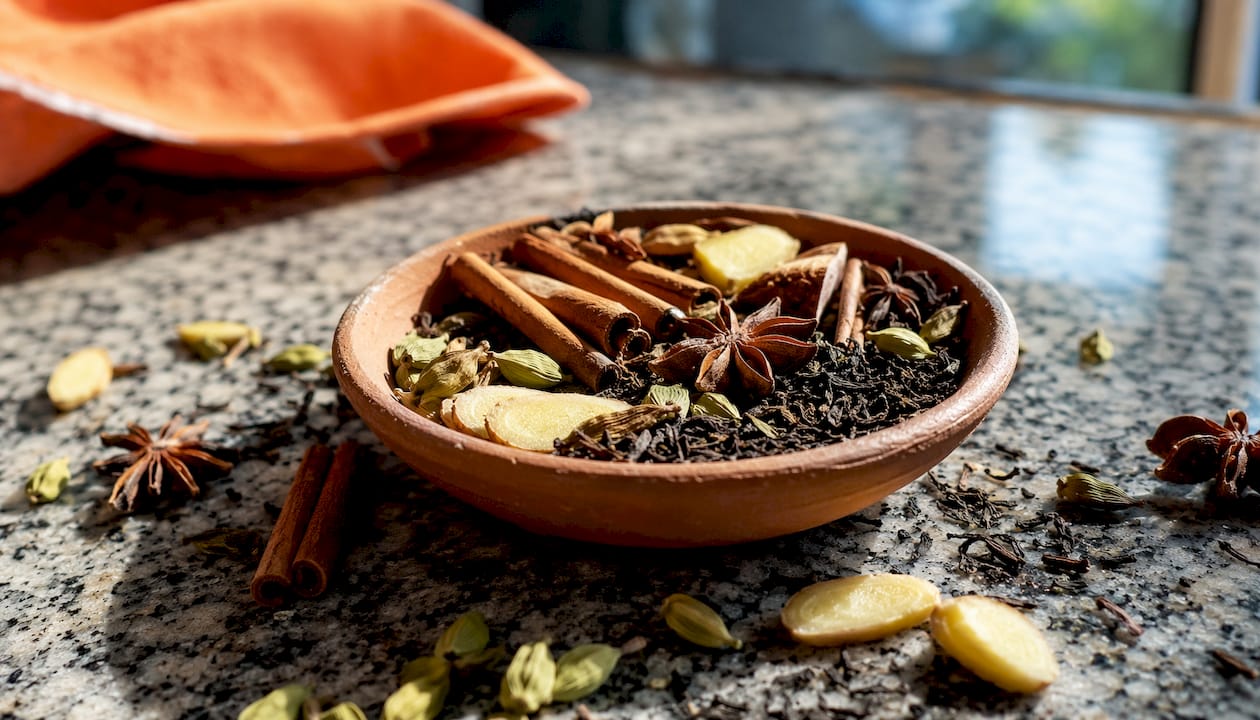
- CTC Assam black tea: CTC stands for Crush, Tear, Curl. These small, pellet-like tea granules extract quickly and robustly, holding their own against milk fats and spice oils. Delicate loose-leaf teas go flat in masala chai.
- Water: The brewing base. Typically equal parts water and milk for a balanced cup, though some recipes run heavier on milk for richness.
- Whole milk: Full-fat dairy gives masala chai its creamy body. Plant milks (oat, coconut, soy) work as vegan substitutes, though oat milk holds up best under heat.
- Sweetener: White sugar is most common. Jaggery (unrefined cane sugar) adds a deeper, molasses-like note that many home cooks prefer.
- The spice blend (masala): This is where the drink gets its character.
The staple spices
- Green cardamom: The aromatic anchor. Crush the pods to release their volatile oils before brewing.
- Fresh ginger: Adds heat and brightness. Fresh root beats ground ginger every time.
- Cinnamon: Brings warmth and a subtle sweetness to the blend.
- Cloves: Intense and slightly medicinal; use sparingly.
- Black pepper: Amplifies the other spices and adds a gentle back-of-throat warmth.
Optional additions that regional recipes often include: fennel seeds, star anise, nutmeg, saffron, and dried rose petals.
Substitutions and storage
Ground spices work in a pinch, but whole spices release more aromatic oil and give a cleaner flavor. If you’re using ground, halve the quantity. A homemade masala spice blend stored in an airtight jar away from heat stays fresh for up to three months. Premade chai concentrate keeps refrigerated for about a week. Leftover brewed chai can be reheated gently on the stovetop — never microwave it at full power, as that scorches the milk proteins and flattens the spice aroma.
How to make traditional masala chai on the stovetop
This is a 2-cup batch. Measurable, repeatable, and close to what a chaiwalla would make.
Ingredients:
- 1 cup water
- 1 cup whole milk
- 2 teaspoons CTC Assam black tea (or 2 tea bags)
- 4–5 green cardamom pods, lightly crushed
- 1-inch piece of fresh ginger, sliced thin
- 1 small cinnamon stick
- 3–4 whole cloves
- 4–5 black peppercorns
- 1–2 teaspoons sugar (or jaggery, to taste)
Method:
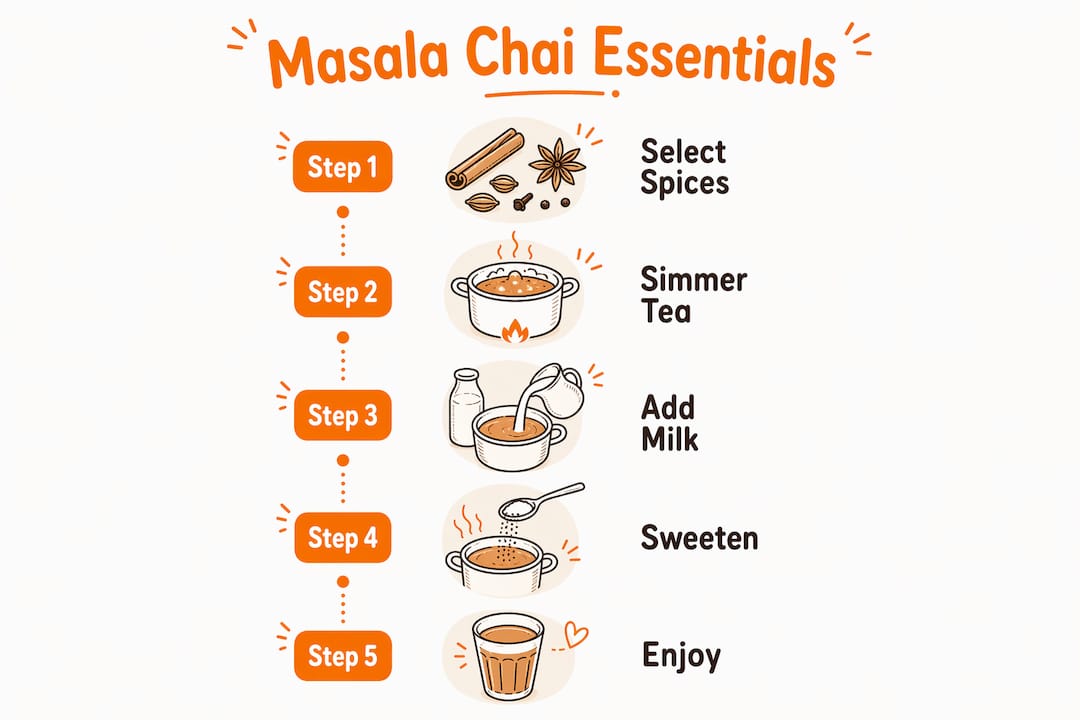
- Simmer the spices first. Add water, cardamom, ginger, cinnamon, cloves, and peppercorns to a small saucepan. Bring to a gentle simmer over medium heat and let the spices steep for 5–7 minutes. This extracts the essential oils before the tea or milk enters the picture.
- Add the tea. Drop in the CTC tea (or bags) and steep for 1–2 minutes only. Adding tea too early or steeping too long is the single most common cause of bitterness.
- Pour in the milk. Add the milk and sweetener. Raise the heat to medium-high and watch the pot.
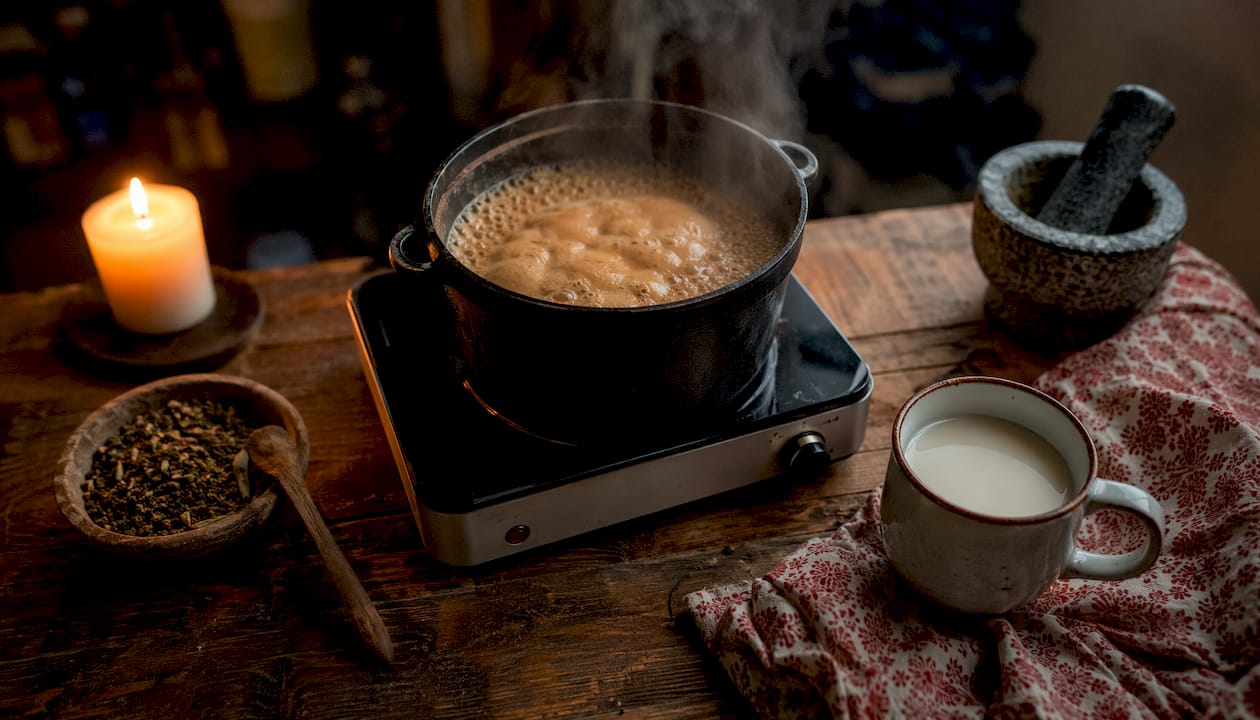
- The 3-rise technique. As the chai approaches a boil, it will rise in the pot. Pull it back from the heat just before it spills over. Let it settle, then return it to heat. Repeat this three times. Each rise deepens the color, thickens the body, and concentrates the flavor through milk protein and tea tannin interactions.
- Strain and serve. Pour through a fine-mesh strainer into cups. Serve immediately.
Pro Tip: Never walk away during the milk stage. The difference between a rich, layered cup and a scorched mess is about thirty seconds of attention. Keep the heat at medium-high, not high, and pull the pot the moment you see the chai climbing the sides.
Faster methods and popular variations
Not every morning calls for a full stovetop ritual. Here are the most practical shortcuts and style variations.
Making a chai concentrate
A concentrate lets you brew once and drink all week. Combine 2 cups of water with double the spice quantities from the recipe above, add 3 tablespoons of CTC tea, and simmer for 15 minutes. Strain, cool, and refrigerate. To make a single cup, mix one part concentrate with one part hot milk. Done in under two minutes.
Five-step stovetop shortcut for busy mornings
- Boil 1 cup of water with 2 crushed cardamom pods and a thin slice of ginger (2 minutes).
- Add 1 teaspoon of CTC tea and steep for 1 minute.
- Add ½ cup of milk and bring to a near-boil once.
- Sweeten to taste.
- Strain and drink.
This skips the full 3-rise technique but still delivers a respectable cup in under 10 minutes.
Style variations worth knowing
- Chai latte (café style): Brew a strong chai concentrate, then top with steamed or frothed milk. This is the coffee-shop version. Note that many commercial chai lattes use presweetened concentrates with artificial flavoring — a far cry from whole-spice brewing.
- Iced masala chai: Brew a double-strength concentrate, cool it, and pour over ice with cold milk. Oat milk works particularly well here.
- Vegan masala chai: Swap whole milk for full-fat oat or coconut milk. Coconut milk adds a tropical note that pairs well with cardamom and cinnamon.
- Elaichi chai (cardamom chai): A stripped-down version using only cardamom as the spice. Lighter, more floral, and faster to brew. This is the everyday chai of many Indian households.
When choosing a premix concentrate, check the label for:
- Added sugar content per serving
- Whether real spice extracts or artificial flavoring is listed
- Milk powder vs. dairy-free base
- Shelf life and refrigeration requirements after opening
Dropoutchaiwala’s chai premix packs are built around real spices like cardamom and ginger, which keeps the flavor honest without the artificial shortcuts most commercial concentrates rely on.
What does each spice actually do?
Understanding the spices is what separates someone who follows a recipe from someone who can improvise one. Each spice plays a specific sensory and functional role.
- Green cardamom: The aromatic anchor of masala chai. Its volatile compounds, linalool and alpha-terpinyl acetate, provide the floral, citrus-edged lift that defines the drink’s signature aroma. Without cardamom, even a well-spiced chai loses its identity. In Ayurvedic tradition, cardamom is considered a digestive and a balancing spice. Dropoutchaiwala’s cardamom chai leans into this spice as the lead note.
- Fresh ginger: Delivers heat and brightness. In traditional Ayurvedic practice, ginger is noted for digestive support and warming properties. Fresh root releases more volatile oils than dried powder, which is why most traditional recipes insist on it.
- Cinnamon: Adds a gentle sweetness and warmth that rounds out sharper spices. Ceylon cinnamon is milder; cassia cinnamon (the common grocery-store variety) is more assertive.
- Cloves: High in eugenol, which gives a slightly numbing, medicinal warmth. A little goes a long way. Two or three cloves in a 2-cup batch is plenty.
- Black pepper: Often overlooked, but black pepper does two things: it adds a dry, peppery heat, and it enhances the bioavailability of other spice compounds. In Ayurvedic terms, it’s considered a catalyst that amplifies the effect of the herbs around it.
Pro Tip: To build your own masala blend, start cardamom-forward (4 pods per cup) for a floral, aromatic cup; go ginger-forward (double the ginger, halve the cardamom) for a spicier, more medicinal profile; or add an extra pinch of black pepper and a second clove for a smokier, bolder finish.
Where masala chai came from
The name breaks down simply: “masala” (spice mix) plus “chai” (tea, from the Chinese “chá”). But the drink’s history is more layered than its etymology.
- Pre-colonial roots: Spiced herbal drinks were part of Ayurvedic practice in India long before tea leaves entered the picture. The original “chai” was a hot infusion of spices and herbs, with no tea plant involved.
- British colonial commercialization: In the early 20th century, the British-owned Indian Tea Association began promoting black tea consumption across India to boost demand for the colonial tea trade. Chaiwallas were encouraged to add milk and sugar to make the tea more palatable and affordable.
- The chaiwalla tradition: Street tea vendors, or chaiwallas, became the primary distributors of masala chai across Indian cities and railway stations. They developed their own regional spice blends and brewing techniques, including the 3-rise method, as a way to produce a consistent, flavorful cup at high volume.
- Domestic evolution: Home recipes diverged from street recipes based on regional spice availability, family preferences, and economic factors. A household in Mumbai might use fennel and less ginger; a Punjabi kitchen might go heavy on ginger and skip fennel entirely.
- Global commercialization: When masala chai reached Western coffee shops, it was repackaged as the “chai latte” — typically a sweetened, spiced syrup mixed with steamed milk. The result is convenient but bears little resemblance to a chaiwalla’s pot.
The gap between a street chai and a café chai latte is significant. One is brewed from whole spices and real tea; the other is often a presweetened concentrate that lacks the fresh spice aromatics entirely.
How does masala chai compare to karak chai and chai latte?
These three drinks share a name and a base ingredient, but they are genuinely different beverages.
| Drink | Milk type | Spice emphasis | Brewing method | Texture |
|---|---|---|---|---|
| Masala chai | Fresh whole milk | Full spice blend (cardamom, ginger, cinnamon, cloves, pepper) | Stovetop simmer, 3-rise | Medium-bodied, aromatic |
| Karak chai | Condensed or evaporated milk | Cardamom-forward, minimal blend | Extended boil for concentration | Thick, intensely creamy |
| Chai latte | Steamed dairy or plant milk | Spice syrup or concentrate | Espresso machine steam wand | Frothy, sweet, mild |
Karak chai — the word “karak” means “strong” in Arabic — originated in the Gulf region and is especially popular in Qatar, the UAE, and Pakistan. Its defining characteristic is concentration and creaminess, achieved by using condensed or evaporated milk and a longer boil. Masala chai, by contrast, prioritizes a balanced spice infusion with fresh milk. The karak chai meaning is essentially “strong tea,” and the drink delivers exactly that: a thick, sweet, almost dessert-like cup.
Regional spice shifts across India and beyond
- Mumbai: Often includes fennel seeds for a slightly sweet, anise-like note.
- Punjab: Ginger-heavy, sometimes with a pinch of turmeric.
- Bengal: Lighter on spices, sometimes with a hint of lemongrass.
- South India: Less common as a daily drink (filter coffee dominates), but when made, often uses less milk and more water.
- Pakistan and Gulf states: Karak-style, condensed milk, cardamom-dominant.
The same term can mean different things depending on where you are. “Chai” in a Mumbai street stall, a Lahore dhaba, and a London café are three distinct experiences.
Is masala chai good for you?
The honest answer: it depends on how you make it. The spices have real traditional and emerging research-backed benefits. The sugar and full-fat milk add calories that can add up.
Caffeine: A standard cup of masala chai delivers less caffeine than a cup of coffee because the tea is brewed and then diluted with water and milk. The spices also change the perceived energy effect compared to coffee — the warmth and aromatic compounds create a gentler, more grounded lift for many people.
Calorie estimate: A standard cup made with whole milk and two teaspoons of sugar contains roughly 90–120 calories, depending on the milk-to-water ratio. A vegan version with unsweetened oat milk and one teaspoon of sugar drops that to around 60–80 calories.
Evidence-based spice benefits:
- Ginger and black pepper are cited in traditional Ayurvedic practice for digestive support and warming properties.
- Cardamom is traditionally noted for balancing digestion and aroma.
- Cinnamon has been studied for its potential role in blood sugar regulation, though research is ongoing.
- Black pepper’s piperine compound is documented in research for enhancing the bioavailability of other nutrients and compounds.
A note on wellness claims: Masala chai’s spices have genuine traditional uses and some emerging research support, but this article is general information, not medical advice. If you have a specific health condition, check with a qualified healthcare professional before using chai as a therapeutic tool.
Common mistakes that ruin masala chai (and how to fix them)
Even experienced home cooks get this wrong. Here’s where things go sideways and how to course-correct.
Mistakes to avoid:
- Adding tea too early: Tea added before the spices have had time to bloom in water leads to a bitter, tannic cup. Always simmer spices for 5–7 minutes first.
- Boiling the milk hard: A rolling boil scorches milk proteins and creates a skin that dulls the flavor. Controlled near-boils are the technique.
- Using stale spices: Ground spices older than six months have lost most of their volatile oils. If your cardamom doesn’t smell floral when you crush it, replace it.
- Over-sweetening: Sugar masks the spice complexity. Start with one teaspoon per cup and adjust after tasting.
- Using weak tea: A delicate green or white tea disappears under milk and spices. CTC Assam is the right tool for this job.
- Skipping the strain: Whole spice fragments in the cup are unpleasant. Always strain through a fine-mesh sieve.
Storage and reheating:
- Brewed chai keeps in the refrigerator for up to 24 hours. Reheat gently on the stovetop over low heat.
- A homemade masala spice blend stays fresh in an airtight container for up to three months.
- Premix packs should be stored in a cool, dry place and used within the timeframe on the packaging.
Key Takeaways
Masala chai is a stovetop-brewed spiced milk tea built on CTC Assam black tea, whole spices led by cardamom, fresh milk, and a sweetener — with the 3-rise technique separating a flat cup from a genuinely rich one.
| Point | Details |
|---|---|
| Definition | Masala chai is black tea simmered with spices, milk, water, and sweetener in one pot. |
| Essential spice | Cardamom is the aromatic anchor; without it, the blend loses its identity. |
| Tea choice | CTC Assam black tea extracts robustly and holds up against milk and spice oils. |
| Key technique | Simmer spices first (5–7 minutes), add tea briefly (1–2 minutes), then milk with 3 controlled rises. |
| Karak vs. masala | Karak chai uses condensed milk and a longer boil for thickness; masala chai uses fresh milk and a spice blend. |
Why authenticity matters more than convenience
There’s a version of this conversation that ends with “just buy the syrup.” That’s not the conversation worth having.
What makes masala chai worth understanding is that every element has a reason. The CTC tea isn’t just a preference — its pellet structure increases surface area and extraction rate, giving the brew a tannic backbone that balances milk fat and spice oil. The 3-rise technique isn’t folklore — it’s a deliberate culinary method that drives milk protein and tannin interactions, producing a richer body and depth than a single boil typically achieves. The spice order isn’t arbitrary — spices need water and heat to release their volatile compounds before milk enters and changes the chemistry of the pot.
The café chai latte is a shortcut that trades all of that for speed and sweetness. There’s a place for convenience, but it shouldn’t come at the cost of understanding what you’re drinking. When Dropoutchaiwala built its masala chai premix, the goal was to preserve the real spices — cardamom, ginger, the full blend — in a format that doesn’t require a chaiwalla’s years of practice to get right. That’s a different proposition from a presweetened syrup. Convenience and authenticity don’t have to be opposites.
The readers who take the time to understand the 3-rise, to smell their cardamom before they use it, to choose CTC over a delicate loose-leaf — those are the readers who will make a cup that actually tastes like something. That’s the whole point of learning this properly.
Reliable sources and further reading
These are the sources worth bookmarking if you want to go deeper on masala chai’s history, spice science, or recipe development.
- Wikipedia: Masala chai — A solid reference for the standard ingredient list, etymology, and regional variations. Good starting point for historical context.
- Consumer Reports: What Is Chai — and Is It Good For You? — Covers the difference between homemade masala chai and commercial chai products, with a focus on health and ingredient transparency.
- Epicurious: Masala Chai Is More Than Just Spiced Milk Tea — Strong on cultural history and the case for CTC Assam tea as the authentic base.
- Delicious Magazine: The Story of Masala Chai and Secrets to a Great Cup — Covers Ayurvedic spice traditions and practical brewing tips from recipe developers.
- CardamomNectar: Cardamom Masala Chai Recipe — Detailed breakdown of the 3-rise technique and cardamom’s role as the aromatic anchor.
- J Cooking Odyssey: Indian Masala Chai — Practical step-by-step recipe with clear order-of-operations guidance and timing notes.
- EatHealthy365: The Difference Between Karak Chai and Masala Chai — Useful comparison of karak and masala chai covering milk type, technique, and texture differences.
- NIH/PubMed Central: Spice bioactivity research — Peer-reviewed research on the bioactive compounds in culinary spices, relevant to the health claims around ginger, cardamom, and black pepper.
- Dropoutchaiwala: Chai Premix Collection — The brand’s full range of authentic spiced chai premix packs, including masala, cardamom, ginger, and classic varieties.
